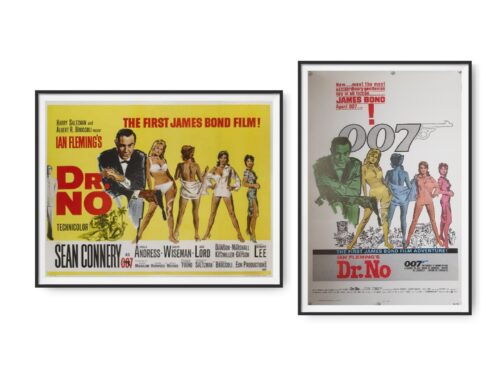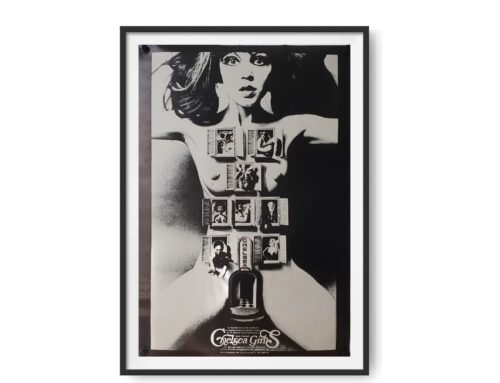
Our most recent movie poster artist profile focused on Saul Bass. This time we examine the work of an artist who could not be more different in style -Robert McGinnis.
Still alive and working at 96, the American artist’s main body of work is often described as illustration. This can be largely attributed to the artist’s popularity in the world of commerce, and he has produced work for book covers, magazines, and, of course, movie posters.
Robert McGinnis was born in Ohio in 1926 and had a love of art throughout his childhood. After High School, he travelled west to California and got an apprentice job at Disney as an animator. His work within the organisation took a change in direction during the Second World War when Disney switched from producing cartoons to propaganda films and training videos for the armed forces.
After Disney, the artist took a job at the Fredman-Chaite commercial art studio in New York. Many of the artists working there at the time subsequently produced notable movies posters. These artists include Frank McCarthy (The Great Escape 1963), Bob Peak (Apocalypse Now 1979) and Mitchell Hooks (Dr. No 1962). McGinnis made his reputation with his work on three different detective novel series – Mike Shayne, Carter Brown and Perry Mason. Attractive (and often scantily clad) females making eye contact with the viewer invariably featured on these paperback novel covers. If men featured, they were cool and detached. These themes were later to feature in the work for which we know McGinnis best.
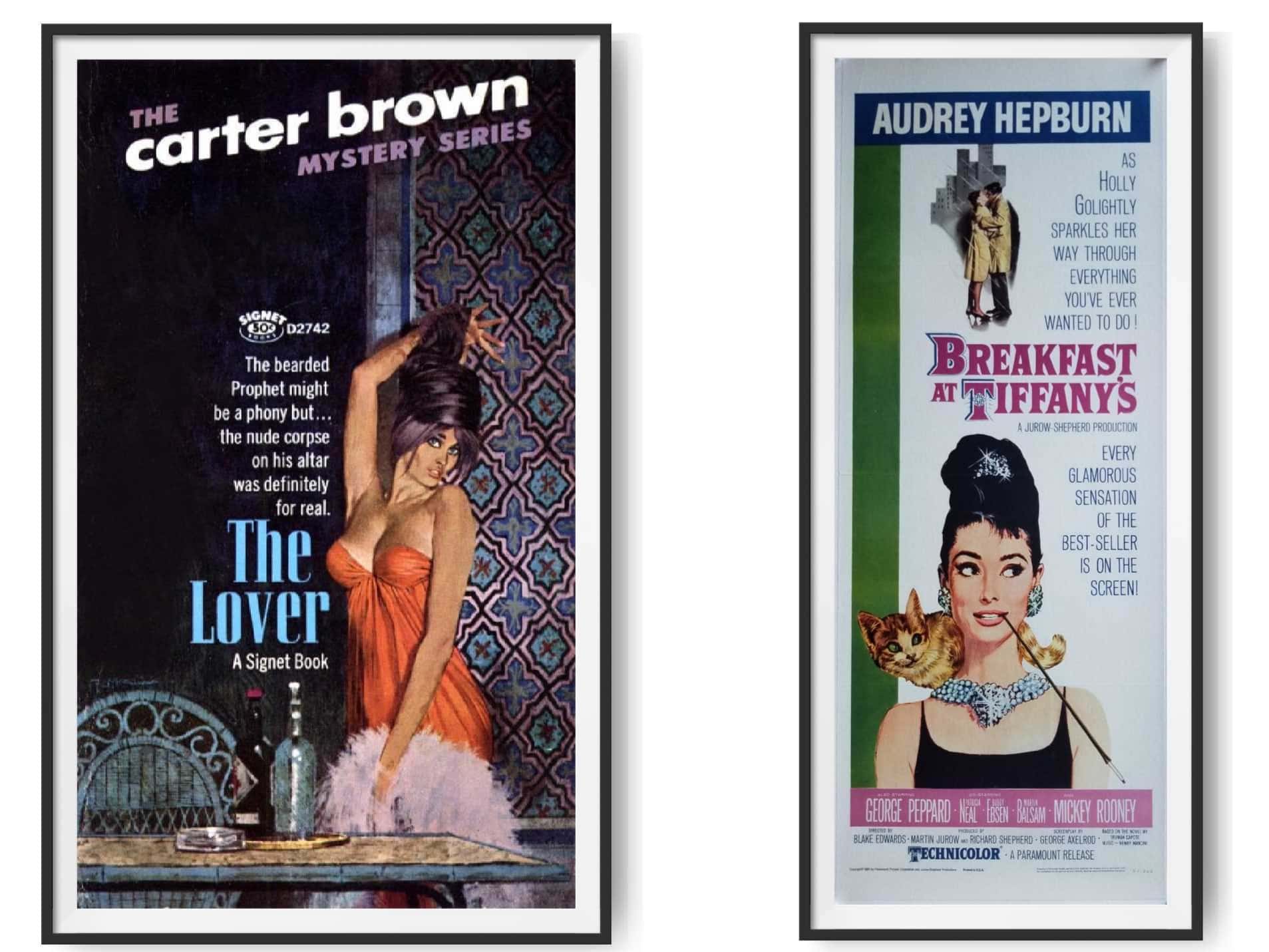
Robert McGinnis illustrated cover's for detective novel's, such as the Carter Brown image on the left, before illustrating movie posters. The Breakfast at Tiffany's poster on the right was the artist first commission for a film.
So on to the movie posters. McGinnis’s first commission for a film was the poster for Breakfast at Tiffany’s (1961). This may sound a bit like a footballers first professional game being the World Cup Final, but by now McGinnis was an established and lauded illustrator. In his book (The Art of Robert McGinnis) about the artist, Art Scott points out how a commission for a film poster is quite different to producing an illustration for a book or magazine. The artist ‘must not only produce the classic 27 x 41 inch one-sheet poster, but also the 3 Sheet, the insert, the soundtrack and LP jacket’.
McGinnis’s portrait of Audrey Hepburn went on to become arguably the most iconic and recognisable picture in movie history. Original first-release posters for the film, featuring McGinnis’s artwork now trade in the 5 figures. Most subsequent re-releases of the films use different artwork or photos of Audrey Hepburn.
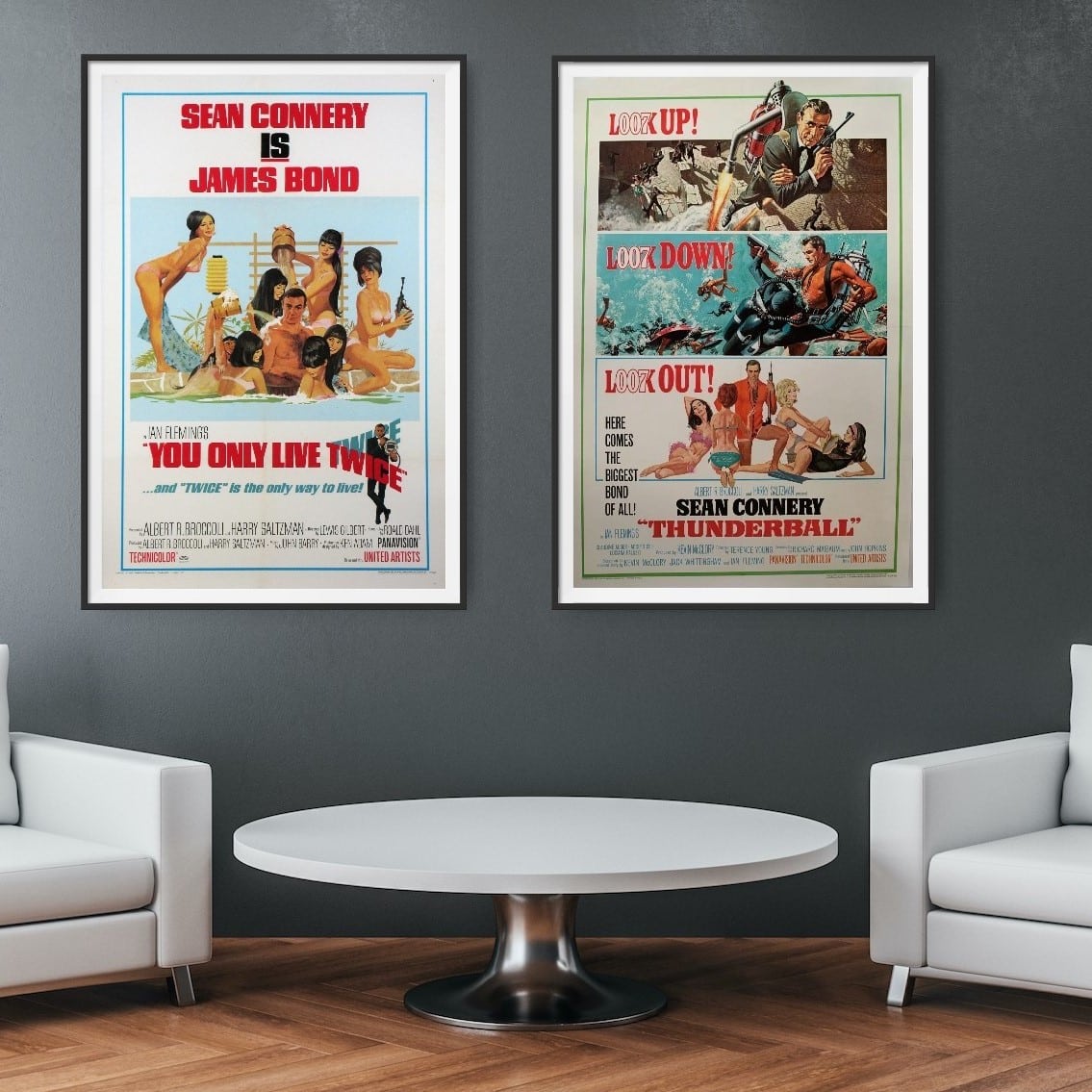
1965 saw the release of the fourth James Bond film, Thunderball, and McGinnis was drafted to produce the artwork which went on to be one of the richest bodies of artwork for any Bond movie. A portrait of Connery surrounded by 4 beauties in swimwear was used for the general release UK quad poster. The advance quad poster had another three illustrations. One features Bond in an underwater fight with another diver, Bond on a Beach firing a speargun through the heart of a diver and Bond escaping SPECTRE with the aid of a jetpack, a scene that must have wowed audiences at the time. A further portrait of Connery in divewear holding a spear gun in one hand and a cocktail glass in the other is a personal favourite. The style is timeless, and the image has been widely re-produced and sold in large chain furniture stores.

McGinnis's artwork was used to brilliant effect in this Scandinavian poster for Thunderball on the left. On the right is the artwork for the 1969 film On her Majesty's Secret Service.
You Only Live Twice was released in 1967 with McGinnis producing all the artwork and it certainly didn’t disappoint. Three major illustrations were produced, and each was used separately on quads, one sheets and US Subway posters. One image features Bond flying little Nellie with no hands, which is almost as comical as the construction of the mini helicopter in the film. Another image feature Bonds in Blofeld’s volcano lair. The third image features the famous jacuzzi scene. While it might be argued that time has shone an unfavorable light on images of this style, they remain hugely popular with the jacuzzi image being the most in-demand of the three discussed above.
By now, McGinnis’s position as ‘the’ James Bond illustrator was without question. However, he did begin to work with Frank McCarthy on some of the artwork. McCarthy produced the artwork of Blofeld and henchmen for On Her Majesties Secret Service while McGinnis produced the portraits of George Lazenby and Diana Rigg. Connery was back as Bond for Diamonds are Forever in 1971 and McGinnis produced both the illustration and design.
Roger Moore arrived as Bond in 1973 and Eon needed a poster that would make a splash. McGinnis’s use of tarot cards worked brilliantly. The likeness of Moore was so strong that the exact same portrait was used for the Man with the Golden Gun the following year. This was to be the artist’s last major campaign for the Bond franchise with Bob Peak producing the much darker themed artwork for The Spy Who Loved Me in 1977.
Other famous movie poster images produced by McGinnis were that of Jane Fonda as Barbarella while the poster for Arabesque captures two of the biggest stars to grace the big screen – Sophia Loren and Gregory Peck. Robert McGinnis went on to produce a diverse body publishing pictures for National Geographic while also painting scenes of the American West and rural landscapes. However, it will likely be the images of Connery as the famous British spy and Audrey Hepburn as Holly Golightly that will live on in the memory of most people.

Posters for the first two James Bond movies starring Roger Moore - Live and Let Die and The Man with the Golden Gun